


In today’s fast-changing world, innovation and digital tools help businesses work better, create new products, and reach new markets. These changes support a strong economy and create more high-value jobs, showing technology and economic growth are closely linked.
Yet economic progress depends on more than technology, including investment, education, infrastructure, competition, and strong institutions. How does technology improve economic growth? In the United States, these factors help explain technology’s effects on productivity and workforce development.
This article explores technology’s links to artificial intelligence, small-business adoption, and public policy. We define productivity, innovation, and automation to show how these forces shape the economy. Together, these ideas explain technology-driven growth and its effects on the economy.
Key Takeaways
- Innovation enhances business efficiency and market expansion.
- Economic progress relies on multiple factors beyond just technology.
- Understanding the U.S. context is vital for analyzing growth.
- Key concepts include productivity, innovation, and automation.
- Public policy plays a significant role in shaping technological impact.
How Does Technology Improve Economic Growth in the United States?
Technology plays a key role in improving U.S. economic growth. It raises productivity, lowers costs, and supports innovation across many sectors. Understanding this link helps explain technology’s effect on the economy.
Defining the Technology-Economy Relationship
The link between technology and the economy works through several channels. Technology raises output per worker and helps businesses produce more efficiently. It lowers production costs and supports business formation through tools that improve operations and market access.
Better access to information helps consumers and businesses make informed decisions. These decisions can stimulate economic activity. Technology can also create new industries and transform the economic landscape.
Historical Patterns of Technological Growth
Historically, U.S. technological advances have driven economic growth. In the late 19th century, the shift from mechanization to electrification marked a turning point. In the late 20th century, computers and the internet changed how businesses operate.
More recently, mobile technology, cloud computing, and technology investment have improved productivity and connectivity. These advances have supported a more dynamic economy and shown technology’s continuing effect on growth.
Measuring the Economic Impact of Innovation
To assess the economic impact of innovation, researchers use several indicators. These include gross domestic product (GDP), labor productivity, and multifactor productivity. Business investment, employment rates, wages, patent activity, and venture capital are also important measures.
Related Posts:
- How Technology Has Impacted Culture Shaping Modern Societies

- What are the Front End Technologies in Java? Your…

- What Are the Benefits of Modern Technology Key Advantages

- Does Technology Isolate People The Social Impact of…

- Unveiling What is IQ.Drive Technology? Your…
- How to Use Technology in Daily Life Practical Tips and Tools

Traditional measures may not fully show technology’s value. Free digital services and better products can improve consumer welfare but often remain outside standard economic assessments. Technology’s benefits also vary across industries, regions, firms, and income groups, so evaluations must consider these differences.
Technology is a fundamental driver of economic growth in the United States. It affects many sectors and economic indicators. Understanding these effects helps policymakers and businesses use technology to support future growth.
For further insights into technology and the economy, visit Brookings Institution.
The Role of Productivity in Sustained Economic Expansion
Productivity and economic expansion work together to support sustainable growth. In a mature economy like the United States, adding workers or hours alone is not enough. Instead, new methods and technology must improve labor productivity.
Businesses can raise productivity by adopting digital tools for business. Enterprise software, cloud platforms, and data analytics help employees finish tasks more efficiently. Collaboration systems and automated workflows help teams work smoothly, make faster decisions, and achieve better results.
Capital deepening means giving each worker more technology and productive capital. These tools and resources can help workers produce more. Successful capital deepening also needs new skills, organizational changes, and strong cybersecurity to protect sensitive information.
Multifactor productivity shows how well businesses combine labor, capital, energy, and materials. Manufacturing, logistics, and healthcare may experience different effects from productivity improvements. For example, new technology can greatly improve efficiency and output across these industries.
Technology investments may not produce gains right away. Firms often need time to redesign processes, train workers, integrate systems, and expand new practices. Therefore, improved productivity takes time but remains vital for long-term economic expansion.
Innovation as the Engine of Long-Term Prosperity
Innovation-driven growth supports sustained economic growth in the United States. It improves products, production methods, and business models. Learning about innovation types helps explain their economic impact.
Types of Innovation Driving the U.S. Economy
Several forms of innovation help advance the economy. Product innovation, process innovation, and new business models support economic advancement.
- Product Innovation: This involves creating new or improved goods and services that meet consumer needs.
- Process Innovation: Enhancements in production or delivery methods that increase efficiency and reduce costs.
- Business-Model Innovation: New approaches to creating, delivering, and capturing value.
- Incremental Improvements: Small adjustments that enhance existing products or processes.
- Breakthrough Technologies: Major advancements that can disrupt markets and create new industries.
Patent Activity and Intellectual Property
Patents and intellectual property foster innovation-driven growth by protecting inventions and helping organizations recover research and development costs. This protection balances competition with the spread of knowledge. The main forms of intellectual property include:
- Patents
- Copyrights
- Trademarks
- Trade secrets
- Licensing agreements
Innovation Hubs and Regional Growth Centers
U.S. innovation hubs, including Silicon Valley, Boston and Cambridge, Austin, Seattle, and Research Triangle Park, shape the nation’s economy. These regions benefit from university and laboratory collaboration, venture capital, specialized suppliers, skilled labor, and anchor companies.
- Collaboration between universities and laboratories
- Access to venture capital
- Specialized suppliers and skilled labor
- Anchor companies that drive regional innovation
However, investment and high-paying technology jobs may gather in only a few areas. Inclusive entrepreneurship and workforce programs can help every region share innovation’s benefits.
| Innovation Type | Description | Impact on Economy |
|---|---|---|
| Product Innovation | Creation of new or improved goods | Increases consumer choice and satisfaction |
| Process Innovation | Enhancements in production methods | Boosts efficiency and reduces costs |
| Business-Model Innovation | New ways to deliver value | Transforms market dynamics |
Digital Transformation Across American Industries
American industries are changing quickly because of digital transformation. This shift changes how businesses operate and deliver value. Companies use digital tools to improve efficiency, customer experiences, and innovation.
This change affects major industries, including manufacturing, financial services, and healthcare. Each sector faces different challenges and opportunities during this digital shift.
Manufacturing and Industry 4.0
Manufacturing is undergoing major change through Industry 4.0, which combines robotics, sensors, and the Internet of Things (IoT). These tools help manufacturers improve operations, raise productivity, and cut costs. Predictive maintenance helps companies foresee equipment failures, reducing downtime and improving efficiency.
Digital twins, or virtual replicas of physical systems, support real-time monitoring and analysis. Connected supply chains improve teamwork and response times, which can raise customer satisfaction.
Financial Services and Fintech
The financial services sector is changing through fintech innovation. Mobile banking, online payments, and automated compliance show how technology is reshaping finance. Financial institutions increasingly use blockchain to improve transaction security and transparency.
These advances also create challenges involving cybersecurity and consumer protection. Organizations must protect sensitive information and maintain customer trust through strong security measures.
Healthcare Technology and Patient Outcomes
Healthcare technology is significantly improving patient outcomes. Electronic health records (EHRs) improve data management, while telehealth expands care access in underserved areas. Remote monitoring and clinical decision support help providers make informed decisions and improve patient care.
Healthcare organizations must address interoperability, data privacy, and employee training. They also need effective workflow redesign to gain the full value of digital tools.
| Industry | Key Technologies | Benefits | Challenges |
|---|---|---|---|
| Manufacturing | IoT, Robotics, Digital Twins | Increased Efficiency, Reduced Downtime | Implementation Costs, Skill Gaps |
| Financial Services | Blockchain, Mobile Banking | Enhanced Security, Improved Customer Experience | Cybersecurity Risks, Regulatory Compliance |
| Healthcare | EHRs, Telehealth | Better Patient Outcomes, Increased Access | Data Privacy, Interoperability Issues |
Technology in American industries needs more than adoption alone. Organizations must build an innovation culture and adapt continually to market demands. An industry expert stated,
“Digital transformation is not a destination; it’s a journey that requires ongoing commitment and adaptation.”
For more insights on technology and economic growth, visit Brookings Institution.
Technology and the Modern Workforce
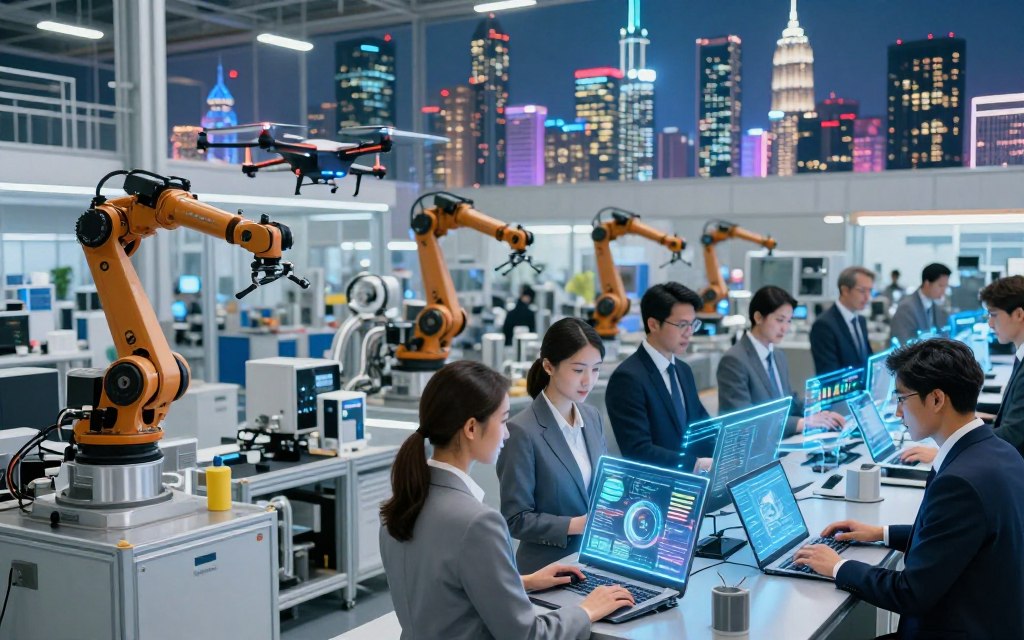
Technology is reshaping the modern workforce in major ways. As technology advances quickly, understanding its effect on automation and employment becomes crucial. This change brings opportunities and challenges, redefining how people work and which skills they need.
Automation and Job Displacement
Automation can improve efficiency, but it also raises concerns about job displacement. Machines now handle many repetitive tasks, while traditional roles continue to change. Automation often targets tasks, not entire jobs, and can create roles needing new skills.
As manufacturing becomes more automated, demand grows for technicians who maintain and program these machines. This change shows why workers need adaptability and readiness for change.
Reskilling and the Future of Work
Reskilling is essential for workers who want to thrive in this changing landscape. Workers need continuous learning to keep up with new technology. Community colleges, apprenticeships, and employer-sponsored training programs help people gain skills that match market needs.
Lifelong education is becoming more important. The future of work will need versatile employees with varied skills. By investing in reskilling, workers can improve employability and adapt to a changing job market.
Remote Work and Productivity Shifts
Remote work has changed traditional work settings. Technology lets employees work anywhere, increasing flexibility and improving work-life balance. Yet remote work creates challenges involving coordination, management, and cybersecurity.
Organizations must manage these issues while supporting remote work productivity. Remote work can also create gaps in career visibility. Remote employees may receive less recognition than colleagues who work in the office.
As companies adapt to this new normal, they must prioritize strategies that ensure fair opportunities for all employees.
Technology affects the workforce in many ways. It can cause job displacement and increase the need for reskilling, but it also creates opportunities. Organizational leaders, educational institutions, and policymakers must work together to build a resilient workforce prepared for the future.
Research and Development Investment in the U.S.
U.S. research and development supports innovation and economic growth. R&D drives technology, productivity, and competitiveness across many sectors. Federal R&D funding and private-sector innovation both play important roles.
Federal R&D funding supports basic research and national priorities. Agencies such as the National Science Foundation (NSF) and the National Institutes of Health (NIH) provide major funding for health research, energy systems, and advanced manufacturing. This funding supports high-risk projects that private firms may avoid because their results are uncertain.
Federal R&D Funding and Priorities
The U.S. government funds research that addresses urgent social challenges. Federal funding supports the following areas:
- Defense technologies
- Health research
- Energy systems
- Advanced manufacturing
- Semiconductors
These investments build a strong knowledge base and help the U.S. lead in innovation.
Private Sector Innovation Spending
Private-sector innovation is also essential. Companies invest heavily in R&D across industries, including:
| Industry | Investment Focus | Examples |
|---|---|---|
| Software | AI and Cloud Computing | Google, Microsoft |
| Pharmaceuticals | Drug Development | Pfizer, Johnson & Johnson |
| Aerospace | Advanced Materials | Boeing, Lockheed Martin |
These investments advance technology and create better products and services for consumers and the economy.
University-Industry Collaboration
University-industry collaboration connects universities with private companies in R&D. These partnerships often include:
- Sponsored research
- Licensing agreements
- Incubators and shared laboratories
- Internships and technology-transfer offices
These partnerships connect theoretical research with practical uses and support innovation.
“Investment in research is not just about funding; it’s about creating a culture of innovation that drives economic growth.”
Challenges include commercialization gaps and intellectual-property disputes. Solving these problems helps maintain a strong pipeline of scientific and technical talent.
The Rise of Artificial Intelligence and Automation
Artificial intelligence adoption is changing operations across American industries. This shift does more than improve efficiency; it changes how businesses operate, innovate, and compete. Wider AI use can support artificial intelligence and economic growth through higher productivity.
AI Adoption in U.S. Businesses
AI adoption is growing quickly among American businesses. Chatbots and data tools improve decisions and customer experiences. Common uses include:
- Generative AI assistants for content creation
- Fraud detection systems in finance
- Demand forecasting in retail
- Medical research advancements in healthcare
- Logistics optimization for supply chains
These tools streamline work and support intelligent automation while creating new business models and revenue streams. AI technologies also help companies respond to market demands and consumer preferences.
Economic Projections for AI-Driven Growth
Economic forecasts suggest AI-driven productivity could greatly strengthen the U.S. economy. These projections depend on several factors, including:
| Factor | Description |
|---|---|
| Adoption Speed | The rate at which businesses implement AI technologies. |
| Data Quality | The reliability and relevance of data used for AI training. |
| Worker Adaptation | The ability of the workforce to adjust to new AI tools. |
| Regulatory Conditions | The legal framework governing AI use and development. |
Together, these factors will shape AI’s effects on economic growth and productivity.
Ethical Considerations and Regulatory Needs
As AI advances, ethical concerns become more important. Privacy, bias, and accountability need attention to support responsible AI use. Companies should adopt practices that promote:
- Transparency in AI decision-making
- Human oversight in automated processes
- Impact assessments for new AI implementations
Responsible AI governance can reduce risks while supporting innovation. Clear records and rules can protect consumers and workers, allowing useful experiments without weakening ethical standards.
Small Businesses and the Technology Adoption Gap
Small businesses support U.S. jobs, entrepreneurship, and local services. Yet many struggle to adopt new technology. Understanding the technology adoption gap is essential for small-business technology adoption, small-business productivity, and growth.
High upfront costs create a major barrier to technology adoption. Many lack capital for advanced technology and may question its return on investment. Limited reliable broadband also makes digital tools for small businesses harder to use.
Cybersecurity concerns create another challenge for small businesses. Many lack technical staff for complex security protocols, leaving them open to cyber threats. Complex vendor offerings can overwhelm owners and delay purchasing decisions.
Barriers to Technology Adoption
Several factors contribute to the technology adoption gap among small businesses:
- High Upfront Costs: Investing in technology can be prohibitively expensive.
- Uncertain ROI: Many small businesses are unsure if the benefits will outweigh the costs.
- Limited Broadband Access: Poor internet connectivity restricts the use of cloud-based tools.
- Cybersecurity Concerns: Fear of data breaches can deter technology investments.
- Vendor Complexity: Navigating various technology options can be confusing.
- Data Privacy Requirements: Compliance with regulations can be challenging.
- Employee Training Needs: Time and resources are needed to train staff on new systems.
Digital Tools Empowering Small Enterprises
Despite these barriers, various digital tools for small businesses can empower companies and improve operations. Cloud accounting, digital payments, and e-commerce platforms can streamline processes and improve efficiency. Customer relationship management (CRM) systems manage customer interactions, while online marketing tools increase visibility.
Scheduling software and inventory management systems can improve daily operations, helping small businesses focus on growth. Cybersecurity services and generative AI assistants offer support, reduce risks, and improve productivity.
Bridging the Digital Divide
Bridging the digital divide requires strategies that help small businesses adopt technology. Affordable broadband lets these businesses use digital tools effectively. Public grants and local business development programs can provide technical assistance, support adoption, and create a supportive environment.
Shared workspaces and partnerships with community colleges can provide resources and training. Trusted advisors can help small businesses choose suitable technology and integrate it smoothly.
Businesses should measure sales growth, operating costs, customer retention, and employee productivity. Technology should solve clear business problems, not follow trends. By solving defined problems, small businesses can build resilience and achieve long-term success.
Policy Frameworks That Support Technological Progress
Strong policy frameworks help new technology grow and support steady economic growth. They use tax incentives, broadband infrastructure, and trade policies to shape the technology landscape.
Tax Incentives and Innovation Credits
The government uses the R&D tax credit to lower costs for companies investing in research and development. This credit encourages businesses to explore new technologies and supports creativity. These efforts also improve global competitiveness.
Broadband Infrastructure Expansion
Broadband infrastructure supports modern technology use. High-speed internet access is crucial for education, telehealth, remote work, and e-commerce. Affordable, reliable service helps rural and underserved urban areas gain fair access to technology.
Trade Policies and Global Competitiveness
Trade policies affect how well U.S. businesses compete around the world. Access to international markets, intellectual property protection, and technology standards strengthen the nation’s competitive edge. Coordinated investment in research, skills, and infrastructure supports trade and technology and global competitiveness.
| Policy Type | Description | Impact on Technology |
|---|---|---|
| Tax Incentives | Financial credits for R&D | Encourages innovation and reduces costs |
| Broadband Expansion | Investment in internet infrastructure | Improves access and connectivity |
| Trade Policies | Regulations governing international trade | Enhances global market access |
In conclusion, a broad approach to technology policy supports innovation and economic growth. By balancing national security with innovation, the U.S. can keep its technology landscape competitive and strong.
Conclusion
The future of technology and economic growth depends on productivity and innovation. As technology advances, it improves economic performance.
Digital tools boost productivity across many sectors. This progress increases efficiency and creates opportunities for new industries.
Innovation supports long-term prosperity. It can change traditional business models and create groundbreaking solutions. For small businesses, technology adoption can level the playing field and help them compete.
Yet, these advances also bring challenges. Job displacement, unequal access to technology, and privacy concerns need attention.
To achieve inclusive economic growth, investments in education, infrastructure, and research are essential. Public policy must support innovation while ensuring that all stakeholders benefit. A balanced approach can help communities, workers, and consumers thrive in this changing landscape.
Looking ahead, the strongest technology-driven economy will foster experimentation and inclusivity. By prioritizing the needs of all economic participants, the United States can harness technology’s full potential for sustainable growth.
 Marcin Wieclaw