

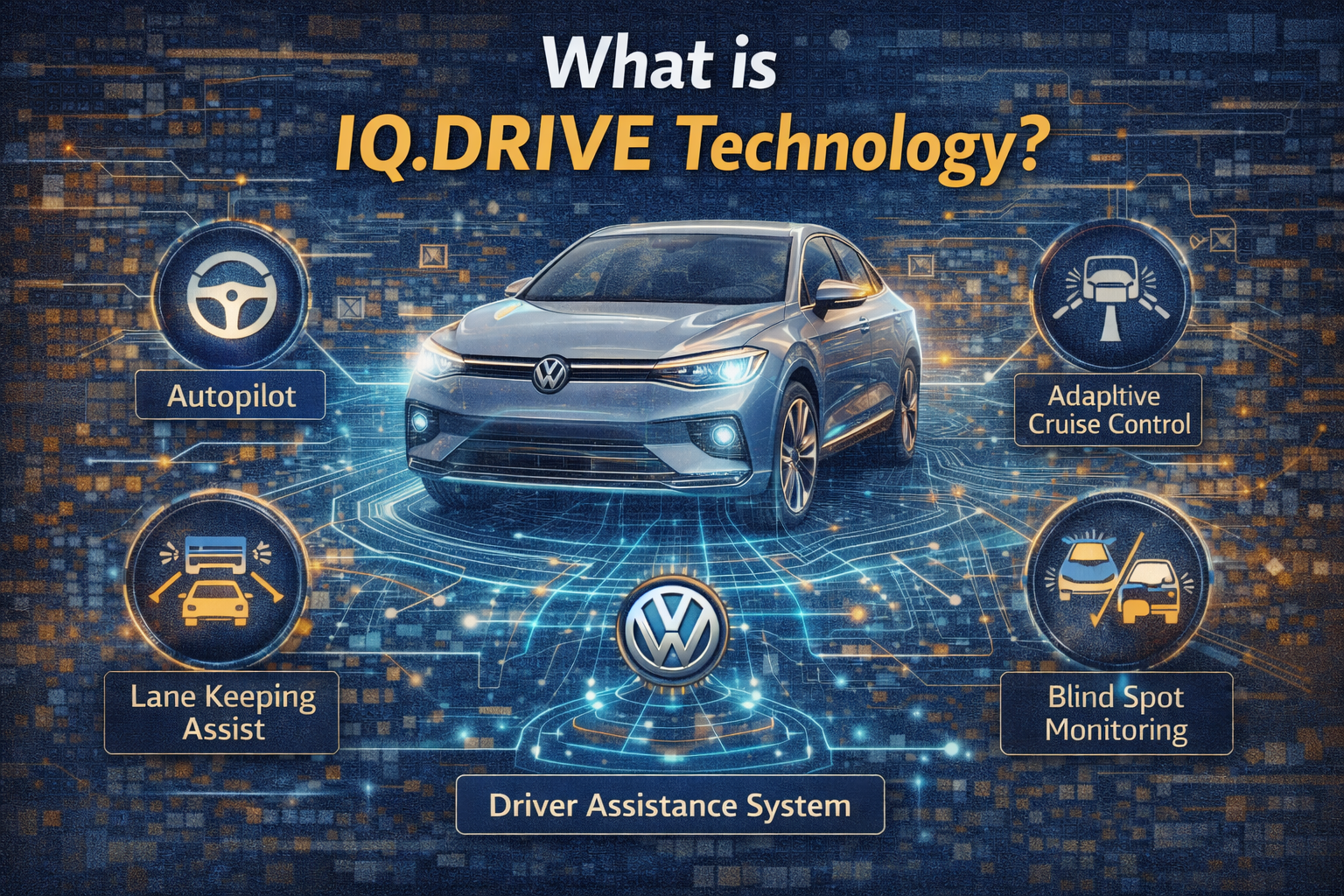
In the rapidly evolving landscape of automotive innovation, advanced driver-assistance systems (ADAS) are transforming the way we experience driving. Among the leading pioneers in this field is Volkswagen, with its sophisticated suite of features known as IQ.Drive technology. As we navigate 2026, understanding what is IQ.Drive technology becomes crucial for anyone considering a modern Volkswagen vehicle or simply keen on the future of automotive safety and convenience. This comprehensive guide will delve deep into the intricacies of IQ.Drive, exploring its components, benefits, and how it’s shaping the driving experience for millions globally.
Key Takeaways
�
�
- IQ.Drive is Volkswagen’s comprehensive suite of Advanced Driver-Assistance Systems (ADAS), designed to enhance safety, convenience, and comfort.
- It combines various technologies like radar, cameras, and ultrasonic sensors to provide features ranging from adaptive cruise control to automatic emergency braking.
- IQ.Drive systems represent SAE Level 2 autonomous driving, meaning they assist with driving tasks but require active driver supervision.
- Key components include Travel Assist, Front Assist, Lane Assist, Side Assist, and Emergency Assist, each contributing to proactive safety and relaxed driving.
- Understanding IQ.Drive is essential for current and prospective Volkswagen owners in 2026 to maximize their vehicle’s capabilities.
The Foundation of IQ.Drive: What is IQ.Drive Technology at its Core?
At its heart, what is IQ.Drive technology? It’s not a single feature, but rather an intelligent ecosystem of interconnected systems working in harmony. Volkswagen has engineered IQ.Drive to be a holistic solution that actively assists drivers in a multitude of scenarios, from congested city streets to long highway stretches. This technology leverages an array of sensors and sophisticated algorithms to perceive the environment around the vehicle, interpret potential risks, and respond proactively, often faster than a human driver can.
Imagine a co-pilot that’s always vigilant, tirelessly scanning for hazards, and ready to lend a helping hand. That’s essentially the role of IQ.Drive. It aims to reduce driver fatigue, prevent accidents, and make the overall driving experience more enjoyable and less stressful. This suite of features is a testament to Volkswagen’s commitment to innovation and road safety, constantly being refined and expanded with each passing year.
The Philosophy Behind IQ.Drive
Volkswagen’s approach to ADAS, encapsulated by IQ.Drive, is built on three core pillars:
- Safety: Minimizing the risk of collisions and protecting occupants.
- Convenience: Reducing the burden on the driver in mundane or challenging driving situations.
- Comfort: Enhancing the overall driving experience, making journeys more relaxing.
These pillars guide the development and integration of every feature within the IQ.Drive umbrella, ensuring a balanced and beneficial application of advanced technology.
Key Components and Features of IQ.Drive Technology
To truly grasp what is IQ.Drive technology, it’s essential to break down its individual components. While the exact features can vary slightly depending on the Volkswagen model, trim level, and region, the core functionalities remain consistent. Here’s a detailed look at the most prominent features:
1. Travel Assist: The Heart of Semi-Automated Driving
Travel Assist is arguably the flagship feature of IQ.Drive, representing Volkswagen’s Level 2 semi-automated driving capability. It combines the functions of Adaptive Cruise Control (ACC) and Lane Assist to provide comprehensive assistance:
Related Posts:
- What are the Front End Technologies in Java? Your…

- How Does VR Technology Work Immersive Experiences Explained

- What Are Web 3.0 Technologies The Next Generation of…

- How to Use Technology in Daily Life Practical Tips and Tools

- How to Disable Intel Virtualization Technology A…
- What Are the Benefits of Modern Technology Key Advantages

- Adaptive Cruise Control (ACC): This system automatically maintains a pre-set speed and a safe following distance from the vehicle ahead. It can accelerate, brake, and even come to a complete stop and resume, making stop-and-go traffic far less demanding.
- Lane Assist (Lane Keeping System): Utilizing a camera, Lane Assist detects visible lane markings and helps to keep the vehicle centered in its lane. If the vehicle begins to drift without an activated turn signal, the system provides corrective steering input and a warning.
“Travel Assist in IQ.Drive seamlessly blends adaptive cruise control with lane keeping, offering a glimpse into the future of effortless highway driving while always requiring driver supervision.”
2. Front Assist: Proactive Collision Prevention
Front Assist is a critical safety component designed to prevent or mitigate frontal collisions. It includes:
- Forward Collision Warning: Using radar sensors, the system monitors the area in front of the vehicle. If it detects a potential collision with another vehicle, pedestrian, or cyclist, it warns the driver visually and audibly.
- Automatic Emergency Braking (AEB): If the driver fails to react to the warning, the system can automatically apply the brakes to reduce vehicle speed and potentially avoid an impact or lessen its severity.
- Pedestrian and Cyclist Monitoring: An extension of AEB, specifically designed to detect vulnerable road users and react accordingly.
3. Side Assist: Blind Spot and Rear Traffic Monitoring
Side Assist enhances safety during lane changes and reversing maneuvers:
- Blind Spot Monitor: Radar sensors in the rear bumper detect vehicles in your blind spots. If a vehicle is detected, an LED indicator in the side mirror illuminates. If you activate your turn signal while a vehicle is in your blind spot, the LED will flash, providing an additional warning.
- Rear Traffic Alert: When reversing out of a parking space, this system can detect approaching vehicles from the sides that may be out of the driver’s direct view. It provides warnings and can even apply the brakes automatically if a collision is imminent.
4. Emergency Assist: When the Driver Can’t Respond
Emergency Assist is a groundbreaking safety feature that can intervene if the driver becomes incapacitated (e.g., due to a medical emergency):
- If the system detects no steering, braking, or acceleration input from the driver after several warnings, it will attempt to alert the driver.
- If there’s still no response, Emergency Assist will safely bring the vehicle to a controlled stop, activate the hazard lights, and can even place an emergency call depending on the region and connectivity services.
5. Parking Steering Assistant (Park Assist)
Taking the stress out of parking, Park Assist can automatically steer the vehicle into parallel or perpendicular parking spaces, with the driver only controlling the accelerator, brake, and gear selection.
6. Light Assist (High Beam Control)
This system automatically switches the high beams on and off based on oncoming traffic or vehicles ahead, ensuring optimal visibility without dazzling other drivers.
7. Dynamic Road Sign Display
Using a front-mounted camera, this feature reads traffic signs (like speed limits and no-passing zones) and displays them on the instrument cluster or head-up display, helping the driver stay informed and compliant.
The synergy between these components is what truly defines what is IQ.Drive technology. They don’t operate in isolation but rather form a cohesive network of vigilance, continually monitoring the surroundings and providing assistance to elevate safety and convenience.
How IQ.Drive Technology Works: The Underlying Mechanics
Understanding the “what” is one thing, but knowing the “how” provides deeper insight into what is IQ.Drive technology. These sophisticated systems rely on a complex interplay of hardware and software:
Sensors: The Eyes and Ears of IQ.Drive
Modern vehicles equipped with IQ.Drive are fitted with a variety of sensors that constantly gather data about the vehicle’s surroundings:
- Radar Sensors: Typically located in the front bumper, these emit radio waves to detect the distance, speed, and angle of objects in front and sometimes behind the vehicle. Crucial for ACC, Front Assist, and Side Assist.
- Ultrasonic Sensors: Smaller sensors often found in the bumpers, used for short-range detection, primarily for parking assistance and maneuvering in tight spaces.
- Cameras: A high-resolution camera mounted near the rearview mirror is vital for lane detection (Lane Assist), traffic sign recognition (Dynamic Road Sign Display), and pedestrian/cyclist monitoring (Front Assist).
- Lidar (Light Detection and Ranging) – Emerging Technology: While not universally present across all IQ.Drive systems in 2026, Lidar is an increasingly important sensor for future autonomous driving, offering highly accurate 3D mapping of the environment.
The Control Unit and Software: The Brains of the Operation
All the data collected by these sensors is fed into a central control unit, often referred to as the Advanced Driver-Assistance System (ADAS) controller. This powerful computer, running sophisticated algorithms, processes the data in real-time:
- Data Fusion: Information from different sensors is combined and analyzed to create a comprehensive, reliable picture of the vehicle’s surroundings. This helps overcome the limitations of any single sensor (e.g., a camera might struggle in fog, but radar can still see).
- Decision Making: Based on pre-programmed logic and machine learning models, the software decides if an intervention is necessary (e.g., warning the driver, applying brakes, providing steering assistance).
- Actuator Control: If an intervention is needed, the control unit sends commands to various actuators in the vehicle, such as the electronic power steering, brake system, or engine management unit, to execute the desired action.
“The seamless integration of diverse sensor data and intelligent software algorithms is what makes IQ.Drive a truly ‘smart’ driving system, capable of anticipating and reacting to complex road scenarios.”
The Benefits of Volkswagen IQ.Drive Technology in 2026
The practical advantages of IQ.Drive are significant and directly impact drivers and passengers. As we move through 2026, these benefits are becoming increasingly valued by consumers:
| Benefit Category | Specific Advantages | Impact on Driver/Passenger |
|---|---|---|
| Enhanced Safety | Reduced risk of accidents (Front Assist, Side Assist). Faster reaction to hazards. Mitigation of accident severity. | Greater peace of mind, fewer potential injuries/damages. |
| Increased Comfort | Reduced driver fatigue on long journeys (Travel Assist). Less stressful in stop-and-go traffic. | More relaxed driving experience, less physical and mental strain. |
| Improved Convenience | Automated parking assistance (Park Assist). Maintenance of optimal speed and distance (ACC). | Simplifies challenging maneuvers, frees up cognitive load for other tasks. |
| Proactive Awareness | Constant monitoring of surroundings. Alerts for potential dangers (Blind Spot Monitor). | Helps drivers stay informed and react effectively to dynamic road conditions. |
| Emergency Support | Intervention in driver incapacitation (Emergency Assist). | Potentially life-saving in critical, unforeseen circumstances. |
In essence, IQ.Drive is about making driving smarter, safer, and more pleasant. It bridges the gap between traditional driving and the fully autonomous future, providing a sophisticated layer of assistance without removing the driver from the loop.
Limitations and Important Considerations for IQ.Drive
While IQ.Drive technology offers remarkable advantages, it’s crucial to understand its limitations. These systems are advanced, but they are not infallible and are not a substitute for an attentive driver. Knowing what is IQ.Drive technology’s full capability also means understanding where it falls short.
- Not Fully Autonomous: IQ.Drive falls under SAE Level 2. This means it can control steering, acceleration, and braking simultaneously under specific conditions, but the driver must remain engaged and ready to take over at any moment. Hands on the wheel and eyes on the road are always required.
- Environmental Factors: Sensor performance can be significantly affected by adverse weather conditions such as heavy rain, snow, fog, or direct, low-angle sunlight. Dirty sensors (e.g., mud on radar or camera lens) can also impair functionality.
- Road Markings and Infrastructure: Lane Assist relies on clear, visible lane markings. Faded, obscured, or non-existent markings (common in construction zones or rural areas) can limit its effectiveness.
- Complex Scenarios: IQ.Drive performs best in predictable environments, like well-marked highways. Highly complex situations, such as navigating multi-lane roundabouts, unprotected left turns, or unpredictable pedestrian movements in dense urban areas, still require full driver control.
- Driver Interaction: The system often requires driver input, such as keeping hands on the steering wheel (even if it’s providing steering assist), to confirm driver attentiveness. Warnings will sound if no input is detected.
“IQ.Drive is a powerful co-pilot, but it’s not a chauffeur. The ultimate responsibility for safe vehicle operation always rests with the driver.”
The Future of IQ.Drive: Evolution Beyond 2026
The development of ADAS is a continuous journey. As we look beyond 2026, Volkswagen’s IQ.Drive technology is expected to evolve significantly:
- Enhanced Sensor Fusion: More sophisticated integration of Lidar, high-definition mapping, and vehicle-to-everything (V2X) communication will provide an even richer and more accurate understanding of the environment.
- Improved AI and Machine Learning: The algorithms powering IQ.Drive will become more intelligent, capable of handling more complex and ambiguous situations, and learning from driving data.
- Expansion of Features: Expect new features that address more driving scenarios, potentially moving towards higher levels of automation (Level 3 or even Level 4 in specific, geofenced areas).
- Personalization: Systems may adapt more to individual driving styles and preferences.
- Over-the-Air (OTA) Updates: Like smartphones, vehicles will likely receive software updates to improve existing IQ.Drive features and introduce new ones without a trip to the dealership.
Volkswagen’s commitment to advancing IQ.Drive underscores its vision for a safer, more connected, and eventually, more autonomous driving future. Each iteration brings us closer to a world where road accidents are dramatically reduced and the stress of driving becomes a thing of the past.
Frequently Asked Questions About IQ.Drive Technology
How to Understand and Effectively Use IQ.Drive Technology
Step 1: Familiarize Yourself with Your Vehicle’s Specific Features
Every Volkswagen model and trim level might have a slightly different set of IQ.Drive features. Consult your owner’s manual to understand exactly which systems are present in your vehicle and how they function. This is the foundational step before using any ADAS.
Step 2: Locate and Understand Controls
Identify the buttons, menus, and indicators associated with IQ.Drive on your steering wheel, dashboard, and infotainment screen. For example, Adaptive Cruise Control (ACC) typically has dedicated buttons for setting speed and following distance. Lane Assist often has an on/off button.
Step 3: Practice in a Safe Environment
Before relying on IQ.Drive in heavy traffic, practice using features like ACC and Lane Assist on quiet roads or highways. Get a feel for how the car responds, how it maintains distance, and how it keeps within lane markings. Understand its limitations.
Step 4: Maintain Situational Awareness
Always remember that IQ.Drive is an assistance system, not an autonomous driver. Keep your hands on the steering wheel, your eyes on the road, and be prepared to take over at any moment. Do not become complacent. The system will alert you if it requires driver intervention.
Step 5: Understand Environmental Limitations
IQ.Drive systems rely on sensors and cameras. Their performance can be affected by adverse weather (heavy rain, snow, fog), dirty sensors, poor lane markings, or bright direct sunlight. Be aware of these limitations and adjust your driving accordingly.
Defined Terms Related to IQ.Drive Technology
IQ.Drive Technology
Volkswagen’s umbrella term for its comprehensive suite of advanced driver-assistance systems (ADAS) designed to enhance vehicle safety, comfort, and convenience. It integrates various sensor-based and camera-based features, such as Adaptive Cruise Control, Lane Assist, Front Assist, and others, to provide semi-autonomous driving capabilities (SAE Level 2) and actively assist the driver in different driving scenarios.
ADAS (Advanced Driver-Assistance Systems)
Electronic systems in vehicles that help the driver in driving and parking functions. These systems are designed to increase car safety and more general road safety by warning the driver of potential problems, or by implementing safeguards and taking over control of the vehicle.
SAE Level 2 Automation
According to the Society of Automotive Engineers (SAE) J3016 standard, Level 2 automation (Partial Driving Automation) means the automated system can control both steering and acceleration/deceleration. The human driver is still required to monitor the driving environment and must be ready to take over control at any time.
Conclusion: Embracing the Intelligence of IQ.Drive in 2026
In conclusion, what is IQ.Drive technology? It is Volkswagen’s intelligent answer to the demands of modern driving – a sophisticated suite of advanced driver-assistance systems meticulously engineered to elevate safety, enhance convenience, and provide a more comfortable driving experience. As we navigate through 2026, IQ.Drive stands as a cornerstone of Volkswagen’s vehicle lineup, offering a compelling blend of human control and technological assistance.
From mitigating potential collisions with Front Assist to reducing highway fatigue with Travel Assist, IQ.Drive features work in concert to create a vigilant co-pilot that makes every journey more secure and less demanding. While it represents a significant leap forward in automotive intelligence, it’s crucial for drivers to remember that these systems are assistive, not fully autonomous. Active driver engagement remains paramount, ensuring that the human element and technological prowess work in perfect synergy.
As the automotive world continues its relentless march towards even greater automation, IQ.Drive technology will undoubtedly evolve. For now, it offers a powerful and practical set of tools that empower Volkswagen drivers to navigate the roads of 2026 and beyond with unprecedented confidence and ease. Understanding and correctly utilizing these features will unlock the full potential of a truly smart and safe driving experience.
Actionable Next Steps:
- Consult Your Owner’s Manual: If you own a Volkswagen with IQ.Drive, thoroughly read the relevant sections to understand the specific features in your vehicle.
- Familiarize Yourself with Controls: Learn where the buttons and settings for each IQ.Drive feature are located and how to activate/deactivate them.
- Practice Responsibly: Begin by using features like Adaptive Cruise Control and Lane Assist on less congested roads to build familiarity and confidence.
- Stay Attentive: Always remember that IQ.Drive is an assistance system. Keep your hands on the wheel, eyes on the road, and be ready to take over.
- Keep Sensors Clean: Regularly check and clean the radar sensors and camera lens (usually on the windshield behind the rearview mirror) to ensure optimal system performance.
 Sally Miles