

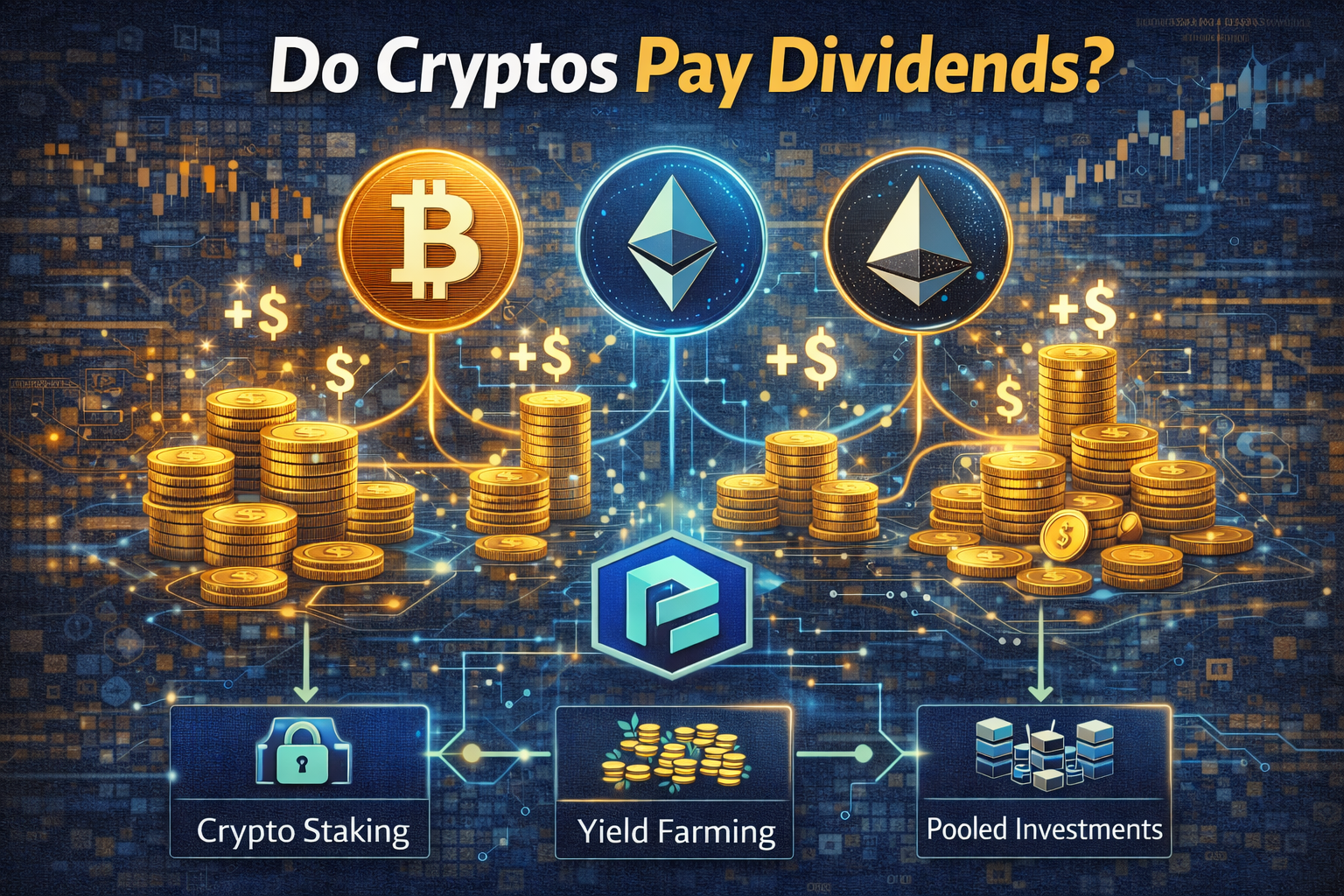
The financial world is constantly evolving, and cryptocurrencies have undeniably reshaped our understanding of digital assets and investment opportunities. A common question among those new to the space, or even seasoned traditional investors, is: do cryptos pay dividends? In the traditional sense of a company distributing a portion of its earnings to shareholders, the answer is largely no. However, the crypto ecosystem, particularly in 2026, has developed a rich tapestry of mechanisms that allow investors to generate passive income, often drawing parallels to dividends. This comprehensive guide will dissect the nuances of crypto-related income, exploring how digital assets can generate returns, and distinguishing these methods from conventional dividend payments.
Key Takeaways
- Traditional dividends (company profit distribution) do not apply to most cryptocurrencies. Cryptos are not equity shares.
- Crypto investors can earn passive income through alternative mechanisms like staking, yield farming, lending, and liquidity provision.
- Security tokens are a notable exception; they are digital representations of traditional securities and can indeed pay actual dividends.
- Each passive income method carries unique risks, including impermanent loss, smart contract vulnerabilities, and market volatility.
- Understanding the distinction between traditional dividends and crypto-native income streams is crucial for informed investment decisions in 2026.
The Fundamental Difference: Cryptocurrencies vs. Traditional Equities
To truly understand why the question “do cryptos pay dividends” often receives a nuanced answer, we must first establish the foundational difference between cryptocurrencies and traditional equities. When you buy a share of stock in a company like Apple or Microsoft, you are purchasing a small ownership stake in that enterprise. As an owner, you might be entitled to a share of the company’s profits, distributed periodically as a dividend. This is a direct financial return based on the company’s performance and profitability [1].
Cryptocurrencies, in their most common forms (like Bitcoin or Ethereum), are not ownership stakes in a company. They are decentralized digital assets designed to function as mediums of exchange, stores of value, or units of account within their respective blockchain networks. When you own Bitcoin, you don’t own a piece of a “Bitcoin company” that generates profits to distribute. Instead, you own a token that derives its value from market demand, scarcity, and its utility within its blockchain ecosystem.
“While the ‘dividend’ concept doesn’t neatly fit into the core ethos of decentralized cryptocurrencies, the ingenuity of blockchain developers has created comparable income-generating opportunities that are reshaping passive investment in 2026.”
Looking at cryptos pay dividends alongside was timeless made unpacking gives a clearer view of the wider topic.
Why Traditional Dividends Don’t Fit Most Cryptos
- No Centralized Company: Most major cryptocurrencies are decentralized, meaning they don’t have a central corporate entity generating profits that can be distributed to token holders.
- Not Equity: Owning a crypto token typically doesn’t confer ownership rights in a business or its future earnings.
- Utility, Not Profit Share: Many tokens are designed for specific utility within a network (e.g., paying transaction fees, governance) rather than as a claim on profit.
How Do Cryptos Pay Dividends? Exploring Crypto-Native Income Streams
While the direct answer to “do cryptos pay dividends?” is generally no, the crypto world offers several alternative mechanisms that allow investors to earn passive income, effectively acting as “crypto dividends” or yield. These methods are intrinsic to the blockchain’s operational models or built upon decentralized finance (DeFi) protocols. Understanding these is key for anyone looking to generate returns from their digital assets in 2026.
1. Staking: The Most Common “Crypto Dividend”
Staking is arguably the closest equivalent to earning interest or dividends in the traditional financial world. It’s a fundamental component of blockchains that use a Proof-of-Stake (PoS) consensus mechanism. Instead of relying on energy-intensive mining (like Bitcoin’s Proof-of-Work), PoS networks secure their blockchain by having validators “stake” a certain amount of their cryptocurrency as collateral [2].
By locking up their tokens, stakers help validate transactions and maintain the network’s integrity. In return, they receive rewards, often in the form of newly minted tokens or a share of transaction fees. The amount of reward typically depends on the amount staked and the network’s current reward rate.
Popular Staking Cryptos in 2026:
Related Posts:

| Cryptocurrency | Consensus Mechanism | Typical Annual Yield (APY) [approx.] | Notes |
|---|---|---|---|
| Ethereum (ETH) | Proof-of-Stake (post-Merge) | 3-5% | Requires 32 ETH to run a full validator node, or can join staking pools. |
| Solana (SOL) | Proof-of-History / Proof-of-Stake | 5-7% | Can stake directly or via validators. |
| Cardano (ADA) | Ouroboros Proof-of-Stake | 3-5% | Delegated staking to stake pools is common. |
| Polkadot (DOT) | Nominated Proof-of-Stake | 10-14% | Can be a nominator or a validator. |
Risks of Staking: While generally considered lower risk than other DeFi activities, staking carries risks such as slashing (loss of staked assets due to validator misbehavior), lock-up periods (inability to access funds for a set time), and price volatility of the staked asset.
2. Lending and Borrowing: Earning Interest on Your Crypto
Decentralized Finance (DeFi) platforms have revolutionized lending and borrowing. Investors can lend their cryptocurrencies to others through smart contracts, earning interest on their deposits. These platforms often operate as liquidity pools where users deposit assets, and borrowers can access these funds by providing collateral [3].
The interest rates can vary significantly based on supply and demand for specific assets, but they often outpace traditional savings accounts. This mechanism is very similar to earning interest from a bank, but in a decentralized and permissionless environment. While not a “dividend” in the traditional sense, it provides a regular income stream from your crypto holdings.
- How it Works: You deposit assets (e.g., stablecoins like USDC, ETH) into a lending protocol. Borrowers then take out loans, paying interest which is distributed proportionally to lenders.
- Key Platforms: Aave, Compound, MakerDAO are prominent DeFi lending protocols in 2026.
- Risks: Smart contract vulnerabilities (bugs in the code), liquidation risk for borrowers (and cascading effects), and regulatory uncertainty.
3. Yield Farming and Liquidity Mining: Advanced Crypto Income
These are more complex, higher-risk, and potentially higher-reward strategies within DeFi. They involve users providing liquidity to decentralized exchanges (DEXs) or other protocols, and in return, earning a share of trading fees, and often, additional governance tokens (liquidity mining rewards) [4].
- Liquidity Provision: Users deposit two different tokens (e.g., ETH and USDC) into a liquidity pool on a DEX. This enables trading between those two assets. Providers earn a percentage of the transaction fees generated by trades within that pool.
- Yield Farming: This is an umbrella term for strategies that seek to maximize returns from crypto assets by moving them between different DeFi protocols to capture the highest possible yields. This often involves providing liquidity, staking governance tokens, or participating in various incentive programs.
While these can generate substantial returns, they come with significant risks:
- Impermanent Loss: If the price of one asset in a liquidity pair changes significantly relative to the other, liquidity providers can suffer a loss compared to simply holding the assets.
- Smart Contract Risk: Vulnerabilities in the code can lead to loss of funds if exploited by hackers.
- High Gas Fees: Frequent interactions with DeFi protocols can incur substantial transaction costs on busy networks like Ethereum.
- Volatility: The value of reward tokens or the principal assets can fluctuate wildly.
4. Security Tokens: The True “Crypto Dividends”
This is where the answer to “do cryptos pay dividends” can be a resounding yes! Security tokens are digital assets that represent ownership in traditional securities like stocks, bonds, real estate, or other revenue-generating assets [5]. Unlike utility tokens or currencies, security tokens are legally classified as securities and are therefore subject to strict financial regulations (e.g., SEC regulations in the US).
Because they represent actual ownership stakes or claims on real-world assets, security token holders can genuinely be entitled to receive dividends, profit-sharing, voting rights, or other benefits, just like traditional shareholders. They bridge the gap between traditional finance and blockchain technology.
- Examples: Tokenized real estate, fractional ownership in companies, revenue-share tokens from blockchain projects that have adopted a securities model.
- Characteristics: Regulatory compliance, often require KYC/AML, potential for dividend payments, voting rights.
- Availability: Still a nascent market compared to utility tokens, but growing as regulatory frameworks mature in 2026.
5. Airdrops and Forks: Opportunistic Distributions
While not a predictable income stream, airdrops and rewards from hard forks can sometimes resemble unexpected dividends. An airdrop occurs when new tokens are distributed freely to existing holders of a particular cryptocurrency, often as a marketing strategy or to bootstrap a new project [6]. A hard fork can create a new version of a blockchain, and holders of the original coin might receive an equivalent amount of the new coin.
These are sporadic and not guaranteed, making them unreliable for consistent passive income, but they can occasionally provide a significant windfall for existing holders.
Understanding the Risks of Crypto Passive Income in 2026
Before diving into any of these income-generating strategies, it is paramount to understand the inherent risks. The crypto space, while innovative, is also highly volatile and largely unregulated compared to traditional finance.
- Market Volatility: The value of both your principal investment and the rewards you earn can fluctuate dramatically. A high yield might be offset by a significant drop in the token’s price.
- Smart Contract Risks: DeFi protocols rely on smart contracts. Bugs, vulnerabilities, or exploits in these contracts can lead to irreversible loss of funds. Audits help but don’t guarantee complete security.
- Impermanent Loss: Specific to liquidity provision, this risk means you could end up with less value than if you had simply held your original assets, due to price shifts between the pooled tokens.
- Platform Risks: Centralized exchanges or lending platforms can be subject to hacks, insolvency, or regulatory crackdowns, leading to loss of access to funds.
- Regulatory Uncertainty: The regulatory landscape for cryptocurrencies is still evolving globally. New laws or restrictions could impact the legality or profitability of certain passive income activities.
- Rug Pulls and Scams: Especially prevalent in newer, less-established projects, “rug pulls” involve developers abandoning a project and making off with investors’ funds.
- Gas Fees: Interacting with blockchain protocols, particularly on networks like Ethereum, can incur high transaction fees, which can eat into potential profits, especially for smaller investments.
How to Explore Passive Income from Crypto (Not Traditional Dividends)
If you’re interested in generating income from your crypto holdings, here’s a general approach for 2026:
-
Understand the Core Distinction
Recognize that traditional dividends from company profits do not apply to most cryptocurrencies. Instead, focus on crypto-native passive income mechanisms like staking or yield farming.
-
Research Potential Crypto Assets
Identify cryptocurrencies that offer passive income opportunities. Look for projects with Proof-of-Stake (PoS) mechanisms for staking, or active DeFi protocols for lending/liquidity provision. Investigate their whitepapers and tokenomics.
-
Choose a Passive Income Strategy
Decide which method suits your risk tolerance: staking (lower risk, often stable returns), lending (moderate risk, interest-bearing), or yield farming/liquidity mining (higher risk, potentially higher returns). Consider security tokens if you’re seeking actual dividends, but be aware of their limited availability and regulatory complexity.
-
Select a Platform or Wallet
For staking, you might use a dedicated staking pool, a hardware wallet with staking features, or an exchange. For DeFi, a compatible Web3 wallet (like MetaMask) and direct interaction with decentralized applications (dApps) are necessary. Ensure the platform is reputable and secure.
-
Fund and Engage Your Assets
Transfer your chosen cryptocurrency to the selected platform or wallet. Follow the platform’s instructions to stake, lend, or provide liquidity. Be mindful of gas fees for transactions on blockchain networks.
-
Monitor and Manage Your Investments
Regularly check your rewards and the performance of your staked or loaned assets. Be aware of market conditions and any changes to the protocol or platform you are using. Understand how and when you can withdraw your principal and earnings.
-
Understand and Mitigate Risks
Educate yourself on risks like impermanent loss, smart contract exploits, and market volatility. Diversify your investments and never invest more than you can afford to lose. Stay informed about the projects you’re involved with.
Key Terminology: Defined for Clarity
Here are some essential terms related to earning income from crypto:
Staking:
The act of locking up cryptocurrency tokens to support the operations of a Proof-of-Stake blockchain network, earning rewards in return for securing the network.
Yield Farming:
A DeFi strategy where users lend or stake crypto assets in various protocols to generate high returns or rewards in the form of additional cryptocurrency.
Liquidity Mining:
A specific type of yield farming where users provide liquidity to decentralized exchanges (DEXs) or other DeFi protocols, earning a share of trading fees and often governance tokens as rewards.
Impermanent Loss:
A temporary loss of funds experienced by a liquidity provider due to price changes of their deposited assets. It occurs when the price ratio of deposited tokens changes from the time they were deposited.
Security Token:
A digital asset that represents ownership in an underlying asset, such as real estate, company equity, or a fund. Unlike utility tokens, security tokens are subject to securities regulations and can pay traditional dividends.
DeFi (Decentralized Finance):
An umbrella term for financial applications built on blockchain technology, aiming to disintermediate traditional financial services by using smart contracts.
Frequently Asked Questions: Do Cryptos Pay Dividends?
No, traditional dividends, which are distributions of a company’s earnings to shareholders, do not directly apply to cryptocurrencies. Cryptocurrencies are not shares of a company, but rather digital assets or tokens operating on decentralized networks. However, crypto investors can earn passive income through alternative mechanisms that share some similarities with dividends.
The primary ways to earn passive income from cryptocurrencies include staking, yield farming, lending, liquidity mining, providing liquidity, and sometimes through security token dividends. These methods involve locking up crypto assets or contributing them to decentralized finance (DeFi) protocols to earn rewards, often in the form of additional tokens.
Staking is a process where crypto holders lock up a certain amount of their tokens to support the operations of a blockchain network, typically those using a Proof-of-Stake (PoS) consensus mechanism. In return for securing the network and validating transactions, stakers receive rewards in the form of newly minted tokens or transaction fees, similar to earning interest.
Yes, security tokens are a notable exception. These are digital representations of traditional securities like stocks, bonds, or real estate, and they can legally entitle holders to a share of profits, voting rights, or other benefits, including actual dividends, much like their traditional counterparts. Their regulatory framework is much stricter, akin to traditional financial assets.
Risks include impermanent loss in liquidity provision, smart contract vulnerabilities, market volatility impacting the value of both principal and rewards, regulatory changes, and platform risks (e.g., hacks, insolvency). Understanding these risks and conducting thorough research is crucial before engaging in any passive income strategy.
Conclusion: Navigating Crypto Income in 2026
The question “do cryptos pay dividends?” highlights a crucial distinction between traditional finance and the decentralized crypto ecosystem. While most cryptocurrencies do not offer dividends in the conventional sense, the innovative landscape of blockchain technology has birthed a variety of sophisticated mechanisms for generating passive income. From the relatively straightforward process of staking to the more complex strategies of yield farming and liquidity provision, crypto investors have numerous avenues to earn returns on their digital assets in 2026.
Crucially, security tokens stand out as the only true crypto assets that can legally and structurally provide traditional dividends, mirroring their real-world asset counterparts. These represent a convergence point between the regulated world of traditional securities and the efficiency of blockchain technology.
For any investor considering these opportunities, a deep understanding of the associated risks—including market volatility, smart contract vulnerabilities, and regulatory uncertainty—is not just advisable but essential. The crypto market operates with a different set of rules and risks than traditional stock markets. Therefore, diligent research, diversification, and a clear comprehension of how each income-generating mechanism functions are paramount. As the crypto space matures, these alternative income streams will likely become even more integrated into broader financial strategies, but always with the caveat that they are not “dividends” in the traditional sense, save for specific security tokens.
Engaging with the crypto economy in 2026 offers exciting possibilities for passive income, but it demands an informed and cautious approach. Always consult with a financial advisor and conduct thorough due diligence before committing capital to any crypto investment strategy. 🌱